Welcome to the November edition of Digital Strategy Quick hits! As always if you find this newsletter helpful, tell a friend!
This month we’re going to talk about tactics. Over the years I’ve seen organization after organization struggle with a mismatch between their goals and their tactics. So today we’re going to focus on how to choose a tactic, some tips for successful execution of the most common digital tactics and a few quick case studies of some successful creative tactics I’ve seen over the years.
How to choose the right tactic
1. What is the ultimate goal here?. As always it’s also important to match your tactic to your theory of change.
2. What has our community proven willing to do in the past? Here is where you should turn to your data to see what actions have driven consistent engagement for you in the past.
3. What is our capacity to run this tactic properly to ensure success? For example, in rapid response moments often urgency is more important than strategically choosing targets so an action with less friction to launch might be the best option.
4. What does success look like? This is often something we forget to overlook when choosing our tactic. Defining success, setting a goal plays a role in deciding which tactic is the best to use in that moment.
I’ve found it useful to have a table put together that defines when each tactic should be used.
The most common confusion when it comes to tactics is whether we should be running a petition or a letter campaign. Here’s the short version of a decision rubric I created for this dilemma:
- Are there pressure targets (elected officials, members of management etc) who are already on our side and others who are not? If yes, letter campaign or call campaign
- Do we want or need to do a public delivery of signatures (with or without comments)? If yes, petition
- Is our action more of a messaging/earned media vehicle to help drive narrative? If yes, petition
- Do we want the pressure to be applied in a more personal, story driven manner? If yes, letter campaign
- Is this action part of a rapid response moment that requires urgency of action? If yes, petition
Tips for successful tactical execution
- Make sure your theory of change is crystal clear, not just in your mind, but for your community too. As I often say about this in trainings, remember that people take actions where they believe that the desire outcome can in fact potentially happen. If there’s no realistic chance in hell of the outcome happening, no one is going to take the action no matter how much you fancy it up.
- Make use of daisy chains to keep supporters engaged beyond the initial action, but remember no daisy chain is infinite. Use the daisy chain to funnel people thru an engagement path for that action that makes sense. Common daisy chain components include sharing with friends and a small donation ask.
- Think about your campaign cadence. Mix up your tactics. If all you ever do is ask people to do one particular kind of action, they’ll get bored or worse, question your strategic sense- both of which end with fewer actions taken.
- Engage in healthy email list management. The majority of your actions will come from your email list, think about things like opt in, respecting people’s inboxes and list segmentation.
- Do the grunt work. If you are doing a letter campaign, for example, take the time to put together a whip count of who the friendlies are and who the opposition is, then run one campaign thanking your champions while “spanking” your opponents (thus the common term for letter campaigns as spank and thank campaigns).
- Report back. I can’t emphasize this one enough. Part of the reason a large percentage of the population has opted out of online actions is that we’ve spent years asking them to take action without giving them any evidence that what they’ve done matters. Don’t just report back on wins…report back on losses followed up with information about how you are changing strategy and what you’ve learned from the losses.
- Get creative. How can you make this action stand out, not just for your supporters but for your pressure targets as well.
Case studies in creativity
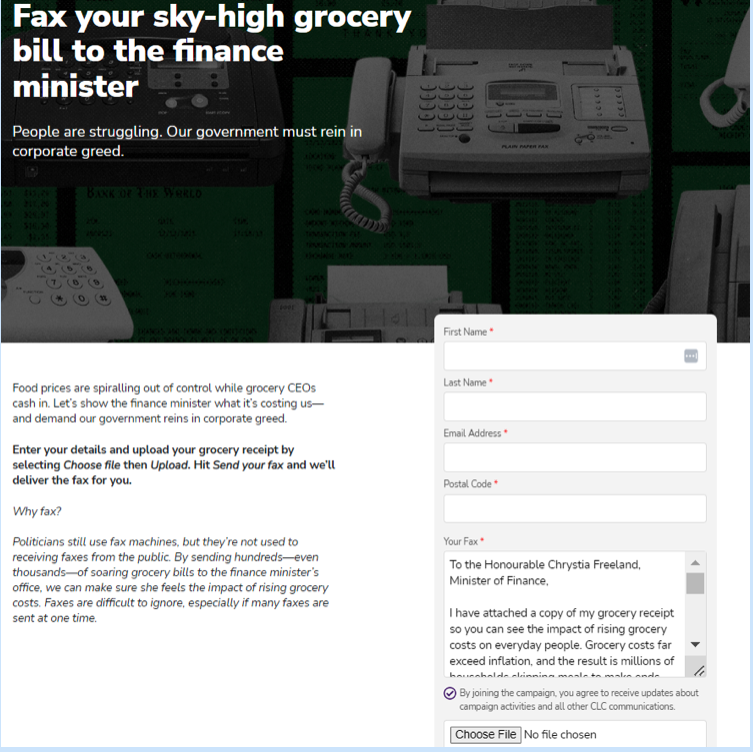
1.My friends at the Canadian Labour Council ran one of the most creative digital campaigns I’d seen in a long time a few years ago. They were leading a campaign to put pressure on members of parliament about the rapidly rising cost of groceries so they ran a campaign asking folks to fax in their grocery receipts to members of parliament to make the point.
3. One idea I’ve always wanted to do but never found anyone willing to do….put a QR code on t-shirts that you have volunteers wear to a rally or protest or parade to make it really easy for people to sign up to your list or take an action.
That’s what I’ve got for you this month. What are some of the most creative tactics you’ve seen? Click reply and tell us and we’ll feature some of the best ones in a future newsletter edition!